Thursday, November 15, 2012

Ghent, Belgium: Beer-y Christmas to Me!

If you tell people you are going to Ghent the response you are most likely to get is, "where?" Assuming you've pronounced it properly and you've explained that it's a city in Belgium you are still likely to get a quizzical look. But as I came to find out, Ghent is a real cool city. It's got some of the charm and personality of Bruges but is also big enough to have a nightlife and culture of its own apart from the tourist scene much like Brussels. 

But I wasn't in Ghent because I'd heard it was a Bruges/Brussels hybrid, I was there to visit a friend I had met way back in Granada, Spain: Kris. Kris accompanied me on the Granada tapas tour one night and, as so often happens, we got to talking about beers. Turned out Kris is in a beer society in Ghent and after waxing Trappist and Spanish beers and all other sorts, he invited me to visit him in Ghent when I made my way through Belgium. Fast forward about 6 months and it was finally time to taste some beers with a master. 

But before I met up with Kris, I did a cursory walk around town- especially through some of the more obscure areas. As with seemingly every city in Belgium, Ghent was a trading town with a port and acquired the majority of its wealth during the late middle ages. I'll spare you the historical drivel on this one and just dive in. From the train station I wanted to proceed to the eastern part of the old town and make my way north to the historic center. To do this I passed through Citadel Park where I noticed something curious.


Each of these headstones displayed the name of a famous museum. I later talked about this with Kris and while he wasn't sure of the meaning either, we both agreed it reminded us of the parks turned graveyards in Sarajevo. Near the park is five-way roundabout intersection. In the middle of the intersection is what my map described as the favorite tree of Ghent. I couldn't figure out what was so special about it but take a long deep look. Maybe it will kindle something deep within your subconscious.


Moving beyond inexplicably loved trees I made my way to the first of many canals that runs behind the St. Peter's church. Since you're still reading Wanderlust after the past 7 entries of canals I'm convinced you love them. So here is another one to whet your insatiable appetite dear reader.


Remember the Beguinage in Bruges? Well if you liked that, this one in Ghent is even more massive. The last Ghent beguine died in 2005 and since the complex has been converted. Regular people now live in these little houses. There are dozens of these little things.


There is also an art cinema that operates on certain days of the week. The church in the center of the garden is still active or semi-active I believe, but the entire site is protected as a UNESCO heritage site so it's unlikely any of this will change in the near future. Look closely and you'll see the little houses going all the way around the perimeter of the churchyard.


But what does the town itself look like? Well, a bit prettier than Brussels but not quite as nice as Bruges. Here is a shot from the canal just east of the very city center. You can see the towers of the Cathedral and the Belfry.
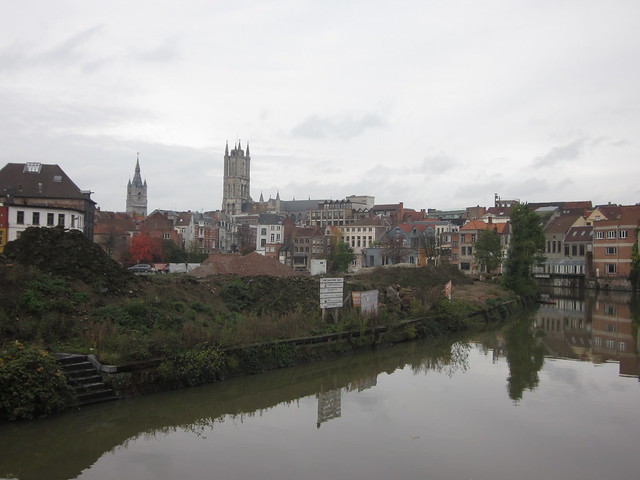

Also, a long time ago the Ghentians decided to fill in some of their canals and replace them with roads. In recent years they have decided to restore a few of them. The Nederschelde canal is among those under restoration. Not sure what the process entails but this is what canal restoration looks like. Just in case you ever need to draw it in Pictionary. 


Feeling a bit peckish and wanting something to fortify my stomach for the beer tasting that was to come, I consulted my trusty map which indicated a plethora of Turkish pizza (pide) options just north of the city center. Supposedly they were good and some of the cheapest food available in Ghent. With little time to spare before meeting Kris I stopped in one and ordered myself some sort of combo pide. What came out for 5 euro was a feast. I only finished about half of it. It was very tasty but was still a far cry from the delicious pides I remember from Istanbul.


Kris asked me to meet him in the Veerle Plein which was convenient as it's right next to the Ghent Castle, Gravensteen. The castle was built in 1180 on the site of a previous wooden castle. It served as the seat of the Counts of Flanders until the 14th century. Subsequently it was used as a court, a prison, and even a wool factory. Eventually it was purchased by the city and restored to its current state. I would have likely gone in even despite the number of castles I've been in over the past 7 months, but I was right on time to meet Kris so a cursory inspection would have to suffice.


Right on time Kris met me at the center of the Veerle Plein and we made our way to the first bar. Along the way I got a nice picture of the canal by the castle at dusk.


One of my favorite Trappist ales is the Orval. A brief primer on Trappist beers. Trappist is a designation given to a monastic order originating from of the Cisctercian monestary La Trappe. These monks brew beers and to be designated "Trappist," the monastery must comply with the Trappist principles/regulations (most importantly that the monastery is self-supporting and all money made from the sale of beer is either used to support the monastery or distributed/used for helping people). 

The beers are generally Belgian top-fermented ales which are bottle conditioned (meaning live yeast is left in the bottle to continue the fermenting process) and they are thereby quite strong. Some breweries (such as Orval) only produce one type of beer, while others produce several usually using a scaling system to identify the strength of the beer. Since the ability to measure alcohol did not exist during the early brewing days, the beers were designated as single (enkel), double (dubbel), or triple (tripel) which indicated the amount of ingredients used. Thus, a tripel had 3x the amount of ingredients as an enkel and would thereby be stronger, heavier, and more flavorful.

There are currently 8 operating Trappist breweries, 6 in Belgium, 1 (the original) in the Netherlands, and 1 relatively new one in Austria. Of these I've tried every beer from 5 of the Belgian breweries and every beer from the brewery in the Netherlands. The 1 brewery I haven't tried in Belgium, Westvleteren, I've been trying to get my hands on for years- only they don't allow their beers to be resold so you have to get them in-person at a designated time from the brewery itself. :(

Anyway, what distinguishes Orval from some of the others is that they use a wild yeast strain. Think back to the Brussels entry where I discussed briefly lambics. Thus, the Orvals tend to age much differently than the other Trappists as the flavor profile can and often does change dramatically over the years. As such, you can buy "old Orvals" in bars around Ghent- Orvals which have been aged for at least 6 months. The one picture above was almost three years old. Similar to aging wine, letting these top-fermented bottle conditioned beers sit for several years allows complex flavors to develop. And this was a great beer... and a foreshadowing of things to come. Here is Kris enjoying his old Orval.


In Ghent's city center there are 5 large edifices of note aside from the Castle. The first is St. Jacob's. It so happened that the next bar we visited was right across the street from the church so I was able to get a photo. We sampled a really tasty amber beer in that bar but the bar itself was equally impressive- exceptionally old and historic looking. I felt as if we had walked back into the 1800's.


The other four are in a line from east to west: (1) Cathedral; (2) Belfry; (3) St. Nicholas; and right across the canal (4) St. Michael's. Before we went on to our final bar of the evening, Kris walked me around the very center so I could take in some of these amazing structures adorned in their nighttime glow. This is the Belfort:


In this one is the bridge, behind which is St. Michael's. The bases for two tower spires were completed but the towers were never built. You can see the left base (the boxy structure in the middle) from this shot of the back of the church.


Maybe my favorite photo of Ghent, however, is the old Graslei harbor where most of the old trading houses were located. It looks spectacular lit up at night. In the summers Ghentians flock to this area to lay out in the sun or even swim in the river.


Also nearby are the historic post office and the old meat markets (which had a tunnel under the river so the carts of meat could be brought into the slaughterhouse). Heading back east past the Belfry you come across the Cathedral also wonderfully illuminated in the evenings.


Ghent, while beautiful in daylight, is simply stunning at night. Personally I think it's more beautiful at night than Bruges and Brussels combined. But despite all of the wonder encircling me, the best part of the evening was yet to come. We retreated back to Kris' place where he offered an exceptionally rare treat: the chance to taste a 35+ year old Orval. These were uncovered in the cellar of a bar which had long since been shuttered and were offered to Kris as a gift from a friend.


The one on the left is from the 1970's. The one on the right is from 2004. Kris called the brewery and had the brewmaster investigate what year they thought it was and late 70's is where they settled. As you can see it doesn't have the extended bands off the label which provide the brewing info, alcohol content, upc label and other information which went into effect in 1982. Drinking a beer that's well older than me- wild. The taste was unlike anything I've had before. The yeast had completely fermented away all of the sugar and what was left was a dry, crisp, and exceptionally flavorful beer. As expected it had a bit of a sour twinge on the finish and there was a considerable amount of sediment.


The glass on the right is the next to last 1/6th or so and the glass on the left is the final 1/6th. Look at the difference in sediment and beer clarity. And the taste of each of these was so different as to think you are having two different beers. But this was from the same beer- the same half of a bottle of the same beer. 

Kris had 9 of these. Two he offered for sample at a function of his beer society and one he offered to share with me. This is an unparalleled treat and one impossible to recreate in a lifetime. I feel so lucky to have had this opportunity! Who is happier than this guy?


Next we tried an exceptional and very limited beer. The first sip of this beer will blow you away. After that it got a bit sweet for both Kris and I, but that first taste just absolutely lights up your palate. The La Trappe Quadrupel Oak Aged.


Finally Kris let me try a beer unique Belgium, a geuze. I can't pronounce it properly but the best I can do is make a throat clearing sound and then say "uhzza." Here in the states you might see it referred to as a "Belgian sour." Although that's not quite accurate, if you've had a Belgian sour you'll have some idea of a geuze. It's a beer made from combining a young lambic (less than 1 year old) with old lambics (2-3 years old). It's then bottle fermented which results in a crisp sour beer with a strong bite. 
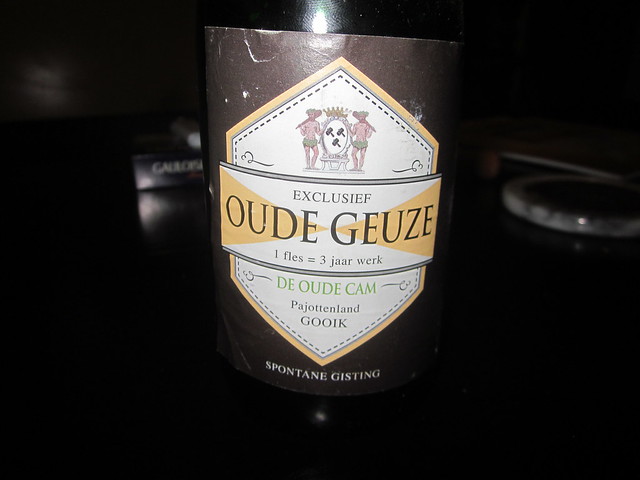

Most foreigners find them too sour, but any self-respecting Belgian beer drinker (i.e. all Belgians) have a fond affinity for geuze much like a proper Englishman respects and even reveres good ale. This particular geuze we tried was the more rare geuze which Kris had been aging for a while. I really like the geuze style- it's perhaps not a beer I would want to drink a large number of (similar to how I feel about IPAs), but a refreshing and unique style I would love to see more American brewers experiment with.

After the geuze it was getting quite late and I needed to make my way back to the train station with as much haste as I could muster to catch the last train back to Bruges. In Belgium it's critical to make the last train as there is no other late night means of intercity transportation. I had a phenomenal time in Ghent and I owe my good friend Kris a huge thank you for taking me on an exceptional beer tour and then capping it off with the tasting experience of a lifetime. And when my friend Kris someday visits the US, I'll be calling on all my beer aficionado buddies to put on a spectacular tasting for him in return.

Wednesday, November 14, 2012

Bruges, Belgium: Romance, Sentimentalism, or Just High on Chocolate?

"If I grew up on a farm, and was retarded, Bruges might impress me, but I didn't, so it doesn't." If you've seen the movie In Bruges you'll no doubt recognize this quote. No post about Bruges would be complete without at least a brief tie in to the film that gave Bruges its greatest spike in international popularity and tourism. If you haven't seen the film or heard of it, it's a funny but crass film starring Colin Farrell as a London-based Irish hitman sent to hide out in Bruges. 

So when I got to Bruges I expected the city and especially the people in the tourist industry (which is pretty much everyone in the city) to be well aware of it. What I didn't expect was how much the city has apparently embraced it. The hostel I was staying in had posters and quotes from the movie all over the place. The free tour was an "In Bruges Free Walking Tour." People readily pointed out sets from the film.

Honestly I had planned to try and force memories of the movie out of my head and just experience it for what it was. But after seeing all of the signage and hearing tour guides talking about it- I couldn't resist. I just had to re-watch it my first night there. And despite still trying to give the town a fair shake, every time something would go even slightly awry I would find myself grumbling under my breath in a Colin Farrell accent, "f*cking Bruges..." It really does get stuck in your head.

My first day there I was still feeling the aftereffects from my drinking tour of Brussels with Rick so I didn't do a whole heck of a lot aside from watch the movie. I did walk from the hostel through the north gate of the city and up to the lone supermarket to acquire some groceries. Along the way I got my first taste of the medieval "fairytale" style houses.


I also purchased some Trappist cheese, in this case Chimay, made by the Trappist monks who brew some of my favorite beer. Those monks must be 400 pounds each since they only produce beer and cheese. That said, if I wasn't so irreverent I could consider that as a potential post-wanderlust career opportunity. A simple life but, with unlimited beer and cheese, a happy one to be sure.

As alluded to in the Antwerp post, Bruges was once one of the most important trading hubs in the world. From the 12th through 15th centuries its port was one of the largest in Europe and with the city strategically situated along trading routes leading from the Hanseatic League to the south and west it passed through more trade than almost any other city. Much of the city's current layout and features were constructed during this period. Around 1500, however, Bruges' channel to the sea gradually filled with sand and Antwerp became the primary shipping and trading destination within Belgium. 

The city fell into decline and by the 19th century was nearly abandoned. In the late 19th century it began to see a resurgence as a tourist destination and new tourism projects renovated, reconstructed, and preserved the medieval look and style of the buildings, thereby increasing this trend. For many decades it was a popular destination among the English and French but in the last half of the 20th century began to become an international destination- an awareness that no doubt exploded even more after the release of the film. These days, the city is renown for it's medieval buildings and romantic canals.


Yay romance. But there are some other interesting things to be found around the city if you fancy a walk just a bit further out of the very city center. For example, did you know there are windmills in Bruges? Bam!


There are actually four working windmills on the easternmost side of the old city center- along what was once the city walls and moat. What else do we know about Bruges? Well its the supposed chocolate capital of the world. I guess that's if you assume that Belgian chocolate is better than Swiss? I don't really know and didn't taste any as I don't like chocolate.

I'll give you a second to get over any shock that last statement may have caused. Despite my general ambivalence to chocolate I must say that there are shops ALL OVER the old town selling homemade chocolates. So if chocolate is your thing, I can recommend Bruges from that angle alone. You'll be in mega-choco-heaven.

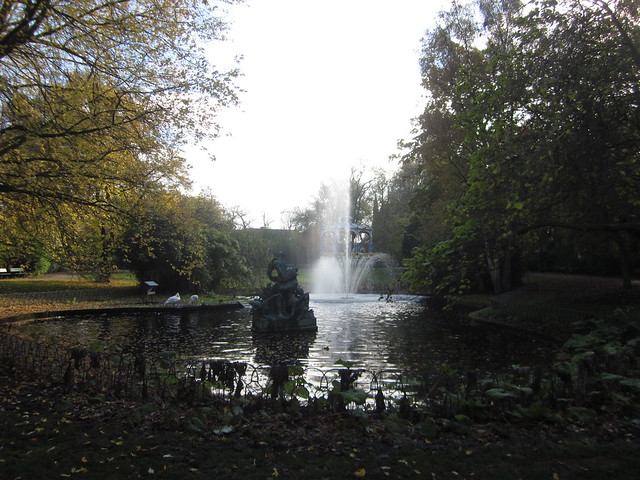
Oh, here is something interesting: Astrid Park. In the film this is where Colin Farrell plans to shoot himself in the head. It's also described on my map as the "frisbee & cute asses park." I can't vouch for the former but I paraded my tuckus through there like I was the King of Belgium. And I nearly fell in the pond taking this picture for you.


Oh! This. This is tremendous. And so freaking creepy! This place specializes in family portrait photography. NUDE family portrait photography. I walked by the window and did a double take, then walked back past it three times to make sure I was seeing what I thought I was seeing. It's tasteful nudes yes, but nude photos of families nonetheless. So bizarre. I tried to get a photo straight on but the shop keepers were glaring at me through the window so this was the best I could do. You wouldn't think owners of a shop displaying photos of nude families in their windows would care much about others photographing them...


This post has certainly taken a turn from what I (and I'm sure you) were expecting- churches, canals, old buildings, etc. So let's get back on track with a nice fountain...


....of two beheaded horses vomiting in opposite directions! HaHA! Why is Bruges so weird? But I'll admit at this point it had started growing on me. I promise there will be more canals and stuff but first, check this out:


That is the courtyard of a Beguinage- a nunnery for beguines. Beguins are an order of mystic nuns started during the 12th century that had some odd beliefs (such as "marrying" themselves to Jesus) that the Church didn't approve of. So they set up these convents where only women are allowed at night. But it's not all hocus pocus- their mission is to help the poor. Keep these folks mind, there's an even more massive one coming up in Ghent. Also, according to my map, this is a good place to make out. I assume that doesn't apply to the nuns but the map was silent to that point so you're on your own there. Anyway, thanks for bearing with me. Here's a canal.


And, for those still reading, a winding old street with lots of medieval buildings AND the Romanesque St. Salvador's Cathedral.


"But Mike, I've heard that the Church of Our Lady is much more beautiful and the canals around it are SUPER romantic. Can we see those?" Abracadabra! In rapid succession, Our Lady seductively dominating the skyline:


Moving in for a closer look, here are some of Our Lady's alluring trappings:


Our Lady's canal:


Our Lady from the rear:


And finally Our Lady's jealous neighbors: 


Phew. I don't know about you but Our Lady wore me out. Fortuitously the old main square is just a short stroll away. In this square are are four things of note: (1) Town Hall (pictured below); (2) Holy Blood Chapel; (3) foundations of the St. Donaas church; and (4) the frog. 


Just to the right of the city hall is a tiny chapel nestled in the corner, the Holy Blood Chapel. In this chapel there is a vial of redish "liquid" that is said to be the blood of Christ brought back from the crusades. Some have alleged that the blood miraculously transforms from solid to liquid form during the hours it is shown. Also the vial is the head of the procession on Ascension Day. I can't say any more on it as I didn't see it for two reasons. One, it wasn't open when I went by, and two, the thought of lining up to look at blood creeped me out. So pulled a Ray and stayed outside.

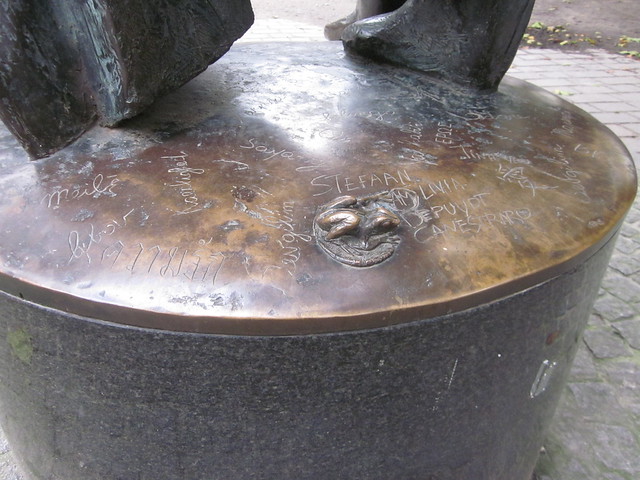
You may look around the Burg Square and ask, "where the hell are these supposed foundations Mike?" They are very sneakily hidden in what is now the basement of the Crown Plaza hotel. But if you walk in and go down to the basement you can check them out. Fun fact: one of the Dukes of Flanders was murdered there while praying. Finally, at the foot of a statue in the center of the square is a bronze frog. My tourist map has apparently created a new "centuries old" tradition whereby passersby have to kiss the frog. If 1,000 people do it will turn into a handsome prince or princess who will "carry your backpack for the rest of your life. For free." Who can pass up a deal like that? Just dive right in there and give that little guy a smooch!


Wow, I've been rambling on and on about windmills and my derriere and nude photography and magic frogs and I've not even mentioned the most popular tourist attraction in all of Bruges. How's that for being awesome? Actually, don't answer that. Anyway, here it is- the Markt with the infamous Belfry that was in 78.31% of all shots from In Bruges according to the Bureau of Statistics I Just Invented.


All of the activity in the center of the Markt is the construction of the winter-season ice rink. The day I arrived in Bruges, Newcastle was playing Bruges in a football match in the whatever-league-is-below-the-Champions-League League. Group play. I have no idea what that means either. But the city was swarming with Newcastle fans (which means the city was ready to party). That night the square had a giant projection screen for the game and about 6,000 Newcastle fans to populate it, chant, cheer, drink, and throw beers. Due to exhaustion and mandated 1 day detox I only saw a bit of the chaos and drank zero beers but the match ended in a 2-2 tie, apparently a huge win for Bruges.

But what does that have to do with the Belfry? Nothing. And what does the view look like from up there? Uh... here.


The two towers everyone loves to hate to love. And here is what the Markt looks like from the tower and probably the last view Ken saw as he plunged to his death (whoops- spoiler alert). You can see the ice rink going up in the middle.


I know I rag on it a little but even with all of the chaos, the Markt is just as quaint and picturesque as they portray it in the film. And at night it really is all lit up and people sit at the various cafes and restaurants drinking Belgian beer. At least until 10 or 11 because by then the city is pretty much dead. It's not just in the square though- the whole city center is pretty much lit up.


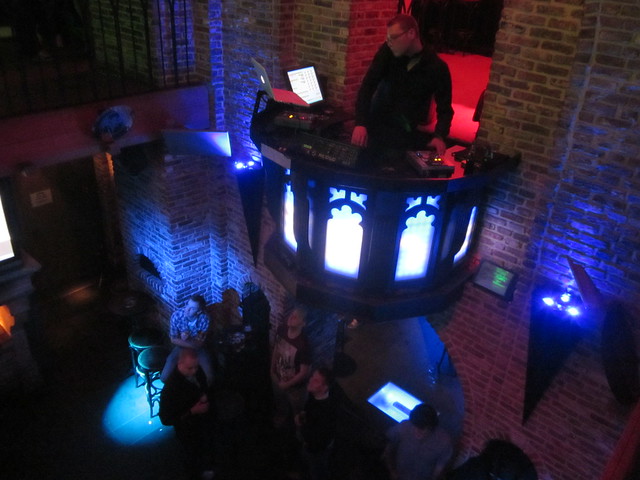
The night after the football match I did go out with my Newcastle friends. Even with all the Geordies in town it was still a quiet night relative to Brussels or anywhere in the Netherlands. That said, one bar had a really cool DJ booth. And the Geordies I was with got him to play Venga Boys. Whoa.


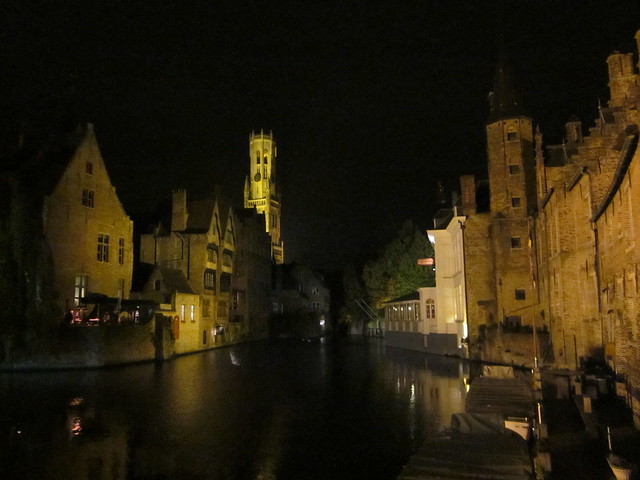
I didn't really do a very good job of keeping this thing within the realm of time/space continuum- all those pictures are from the duration of my stay. Here's a brief recap in case you are confused. Day 1: did nothing. Day 2: walked around, did "In Bruges" tour, went out with Newcastle people. Day 3: I went to Ghent (covered in the next post). Day 4: walked around the city a bit more before doing a final repack and some writing. Guess what I saw on my walk? More canals!


The reason I decided to do my final repack in Belgium rather than France or even England was twofold. One, I bought a few Trappist ales in Belgium that needed to be properly packed. Two, and more importantly, the shoes I bought in Hamburg for 30 euro completely wore out! Look at this!


That was in 3 weeks. German engineering my ass! Germans do a great job of making lots of things but apparently kicks are not among them. It's no wonder they lost the war- everyone was walking around with holes in their shoes. With these dead, my NB's out of commission, and it being too cold for sandals, I had no choice but to go the rest of the way with my hiking boots which were at the very bottom of my pack.

Anyway, Bruges isn't the "shithole" claimed by Colin Farrell in the movie. But it is about as advertised. It's charming and old and romantic. There's lots of towers to climb and chocolate shops to check out. It's a bit quiet at night and it's swarmed with tourists and shops/restaurants/cafes catering to tourists. I could see it as a nice holiday destination for the girlfriend, wife, or family, but as a solo traveler you really only need 1-2 days here tops. The one disappointing thing? No racist midgets.

I'll leave you with this note I wrote as I was leaving Bruges: "Standing at the bus stop outside the hostel and I'm running through all of the things I need to do in the next week before I fly back home and all of the stuff in the first week back and then I'm reading the bus schedule times and I notice these two blond Belgian girls a few feet away staring at me. It is at this exact moment I realize I've been saying all of this aloud rather than just thinking it."

Bonus Photo: A few of you dear readers may have noticed a distinct lack of an obligatory photo of your Wanderlust capitano. Here I am at the top of the Belfry. Hot from the climb but freezing my ass off in the wind. Good thing I had already strutted that bad boy.


Sunday, November 11, 2012

Antwerp, Belgium: "Don't Diamonds Come From Antwerp?"

Why yes, yes they do. If you've seen the film Snatch you'll recognize that as one of the opening lines from the film wherein Freddy Four Fingers and his crew knock off an Orthodox Jewish jewelry depository in Antwerp for an 86 carat diamond before fleeing to London. Diamonds are big business in Antwerp- in fact the diamond industry there accounts for around 10% of the economy of Belgium.

That said, there's much more to Antwerp than just diamonds, and it starts with Antwerp's long history as an important port city. At the end of the 15th century the port outlet of Bruges turned to sand and thus all of the important Belgian trading houses moved to Antwerp and established that city as the new port hub of Belgium. Riches and all of the trappings followed and Antwerp became not only an economic hub but also an epicenter for culture, harboring painters, writers, and musicians.

I decided to visit Antwerp not for the diamonds but for the accounts I'd been hearing about their old town and the extremely unique train station. Yes, the train station. Unless you come by car, boat, or parachute into the city, the train station is going to be the first thing you encounter. So if you don't like the rest of this post, my advice to you is take a walk around the station, grab a waffle, and then make your way back to wherever you came from.

Why is the station so unique? Most train stations operate horizontally- that is the trains come in beside each other on various platforms. In Antwerp the station operates VERTICALLY, meaning, you guessed it, the trains come in on top of one another. I counted about four different levels of platforms.


Someone had told me about this way way back in the summer and I'm ashamed to admit that I had forgotten it was Antwerp. I vaguely remembered that I was going to encounter an odd train station somewhere along the trek through Belgium but it wasn't until I arrived in Brussels and took a look at the Antwerp map that I remembered. But the interior configuration isn't the only thing of note about the train station. When they expanded it, they incorporated the original entrance, upper level tracks, and facade of the old station. So before going down the series of escalators to your track you get to walk through the entrance just as all passengers have since 1905.


Before hitting the old town I made my way north to check out a "wasteland" that has been converted into park space as well as a stunning new museum built to transform the old port area once again into a thriving neighborhood. On the way, however, I was able to get to the bottom of a mystery that had been plaguing me since day 1 in Brussels... cheese crack! First of all, you'll find little fry shops all over Belgium. And they're not just making up frites- they'll fry up a whole host of other frozen or quasi-frozen items. Check out this spread:


Among some of those items was deep fried tacos, assortment of Italian cheeses, frozen liver, meat kebabs, a "mexicano," and of course cheese crack. What is cheese crack? Well... it's similar to a giant mozzarella stick only instead of just melted cheese it's more of a cheese saucy thing. It wasn't that great but I also got a Bicky burger which is just a hamburger but with a fried frozen patty instead of a grilled fresh one. Meh. I'm incurring irreparable damage to my internal organs to bring you these facts dear reader.


Antwerp isn't just a city wallowing in the spoils from it's rich history as a port city, it's also a modern and extremely active port. In fact, it's the SECOND largest active port in Europe, which means I've been to all three of the largest port cities in Europe! Magnificent! Antwerp's main port is a bit far out of the city but you can see it off in the distance of this shot from near the old port.


And speaking of the old port, I got this great shot from right around the corner. The clouds behind the ship looks like sails... I'm not used to seeing blue skies in the Netherlands & Belgium so this day was a much appreciated treat.


The main thing to see now in the old port is the Mas museum. It's currently housing a selection of Belgian arts while the Royal Fine Arts Museum is closed until 2017. But the best part is you can ride the escalators all the way to the top for an unobstructed view of the city. From here you can see a couple of things: (1) the old town;


(2) the obligatory photo of yours truly;


and (3) some window washers taking care of the really cool curved windows (which I assume cost a fortune);


But what does this acclaimed winding port-laden structure look like? Kind of like a brown-brick Lego house. Look how high up those window cleaners are.


From here it's an easy hike down to the old town, you simply need to walk through a roughly 6 block rectangle complex of red light district that was not included on my map. I'm certainly getting an inadvertent education on the great red light districts of Northern Europe. Anyway, after you've run the gauntlet, you'll find yourself in the Grote Markt which is occupied by the exceptionally well-adorned city hall.


It's actually less of a "square" and more of a triangle. And since it was finally a nice day, here's a shot of the Grote Triangle with the Cathedral in the background.


"Tell me more about the Cathedral!" Fine fine. So they started building it in 1352, and it stalled. But then the did eventually complete one of the two planned towers in the early half of the 16th century. But... as you've probably already noticed... they only got that far. However, they had already started the base of the second tower so, why not just cap it off with a little spire and call it a day?


Haha. I can't get over how ridiculous that looks. In Cologne they're all fired up about their cathedral but at least it's complete. Anyway, if you're clever and handsome like me you'll be able to find the tiny little road wherein lies the most well preserved example of a typical old school Antwerpian street. Or so they say. But it's quaint and winding and perfect for someone as charming as yourself.


Also, apparently nearby is the first skyscraper on the European continent. I don't know how one defines a "skyscraper." My thought being that the first skyscraper is just the tallest building, surpassed by the next tallest and so forth. But, no, apparently this one is. Before this, no buildings in Europe could be said to scrape the sky.


The best view of the buildings in the old town is from the Groen Plaits. It's also near the home of Rubens, one of Antwerp and Belgium's most famous painters. I don't particularly love his work so I'll give you the shot of the square with the buildings instead of the picture of his boring house.


After the Train Station and the Mas, my third favorite part of Antwerp is a bit of a local treat. Near Rubens' house there's a building alongside the water. In the building there is an elevator. If you go down the elevator you'll find a tunnel. It looks like this:


And it takes about 15-20 minutes to walk from one end of the tunnel to the next. And when you come to the end of the other side you'll see some old school wooden escalators that look like this:


And when you go up the escalators you come out on the other side of the river and you can look back and BAM. There's the city. And you're all alone because no one goes there to look out at the city. So there you are, there is the city, and you're looking out and it's really nice and you can think about your successes and your failures, your past and your future... and as you contemplate your future one definite certainty will suddenly strike you and that is... you have to walk back through the tunnel.


I walked around Antwerp for quite a while after I made it back through the tunnel. But there are really only a handful of things worth bringing to your attention. One, the most massive squares in the entire city is not a square- well it is. But it's used as the largest parking lot in the city. I just don't understand. Perhaps this square hasn't been swept into the modernization plan for the city. Or... I don't know. I was confused. There's so much potential for public green space... But here it is:


And at the end of the long long long parking lot is the Palace of Justice. It's new. And it's got a weird design. Some call it shark-like. I think it looks like the Arwings from the game Star Fox. That's the only reason you get a picture.


Anyway, I've gone on and on about all of the other things in Antwerp but I haven't shown you the diamond district. Well, here's the main drag. Apologies for the blurriness but I had to take it quick. There are a ton of cameras everywhere and I was anticipating someone grabbing me at any moment. Apparently Snatch put the spook into them.


As you get back toward the station (which the diamond district borders) you'll change from the diamond headquarter buildings to actual diamond shops with literally thousands upon thousands of diamonds in display in the windows. This was one small shop of maybe 30.


Finally it was time for me to return to the station and back to Brussels. But before I did I needed to make good on the last Belgian treat I had yet to try- Belgian waffles. And there just so happened to be a little cart in the station hawking fresh waffles. I decided to go all out and get a fresh one with chocolate sauce and cream. It was awesome. Too awesome actually. I felt like the sugary doughy awesomey goodness might actually be the death of me. And what a glorious death it would be.


After the Brussels post I know you must be stunned by the relative straightforwardness of this post. But that's how I like it- keep you guessing dear reader. Will Bruges be insanity or boring? History or company? Food or fun? Who knows! But Antwerp was aight. Good weather and all...